



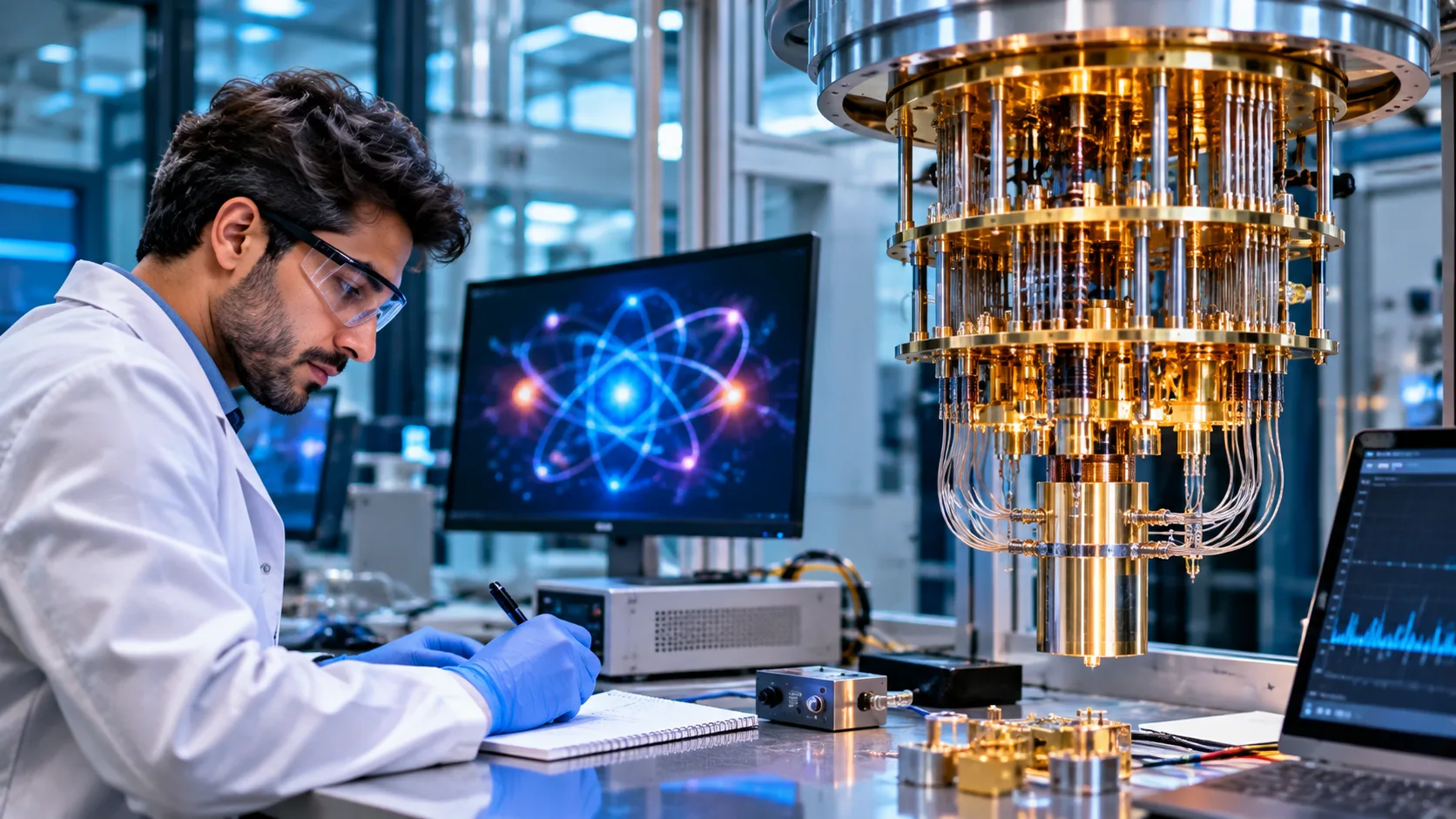
Quantum engineering may sound difficult, especially if you are unfamiliar with advanced science and technology. You might wonder what it means, how it works, and why it matters in everyday life. The good news is that you do not need a background in physics to understand its basic concepts.
From accurate navigation systems to advanced computers, quantum technology is changing how engineers solve complex problems. This guide explains its meaning, practical uses, benefits, and challenges through simple examples.
What Is Quantum Engineering?
Quantum engineering is a field that combines quantum physics with engineering to develop advanced technologies. It focuses on understanding and controlling the behavior of tiny particles, such as atoms, electrons, and photons.
Traditional engineering follows the rules of classical physics. However, quantum technology uses principles that describe how matter and energy behave at extremely small scales.
The main goal is to turn quantum science into practical tools and technologies. These include powerful computing systems, sensitive measuring devices, precise clocks, and advanced communication networks.
For example, engineers can use the behavior of atoms to develop highly accurate clocks. These clocks help support navigation, scientific research, and communication systems.
How Does Quantum Technology Work?
Quantum technology works by controlling the physical properties of tiny particles. These particles behave differently from everyday objects, allowing scientists to explore new ways of processing information and performing measurements.
Three important quantum mechanics principles help explain how this technology works.
Superposition
Superposition allows a quantum system to exist in a combination of possible states before measurement.
For example, a traditional computer bit represents either 0 or 1. A quantum bit, also called a qubit, can exist in a combination of these states.
Quantum Entanglement
Quantum entanglement occurs when two or more particles share a connected quantum state. Measurements of these particles can produce strongly related results, even when the particles are far apart.
Researchers study this property to develop quantum networks, computing systems, and advanced communication technologies.
Quantum Interference
Quantum interference occurs when different quantum possibilities combine, strengthening some outcomes and weakening others.
Quantum computers use carefully designed operations to increase the chances of obtaining useful results for certain types of problems.
Main Types of Quantum Technology
Quantum science supports several areas of technological development. Each area focuses on solving different problems using the behavior of matter and energy at small scales.
Quantum Computing
Quantum computing uses qubits instead of traditional computer bits to process information. It may help solve certain complex problems that are difficult for conventional computers.
Researchers are exploring its potential in molecular simulations, materials science, and mathematical problem-solving.
Quantum Communication
Quantum communication uses quantum states to transmit or share information. One important application is quantum key distribution, which can help detect certain attempts to intercept cryptographic keys.
Researchers are also developing quantum networks that could connect different quantum devices.
Quantum Sensing
Quantum sensing uses the properties of particles to measure physical changes with high precision. These measurements may include temperature, magnetic fields, gravity, and time.
Such technology is useful in scientific research, navigation, environmental monitoring, and medical imaging research.
Quantum Simulation
Quantum simulation uses controllable quantum systems to study other complex quantum systems. It helps researchers investigate materials, chemical reactions, and particle behavior.
This approach could improve our understanding of processes that are difficult to model using traditional computers.
7 Real-World Uses of Quantum Technology
Quantum systems have both established and emerging applications. While some technologies are already widely used, others are still being developed and tested.
Here are seven important applications.
1. Healthcare and Medical Research
Quantum computing could help researchers understand complex molecular structures. This may support the discovery and development of new medicines in the future.
Quantum sensors are also being studied for their ability to measure weak biological signals. However, many advanced medical applications remain experimental.
2. Cybersecurity and Data Protection
Quantum communication introduces new methods for protecting information during transmission. Quantum key distribution can help organizations detect certain forms of interference during key exchange.
It does not eliminate every cybersecurity risk. Organizations still need strong security policies, reliable software, and appropriate data protection measures.
3. Navigation and GPS Systems
Atomic clocks use quantum properties to measure time with exceptional accuracy. Accurate time measurements are essential for satellite navigation systems such as GPS.
Researchers are also exploring quantum sensors that could support navigation in environments where satellite signals are unavailable or unreliable.
4. Artificial Intelligence
Researchers are studying how quantum computing might support certain machine learning tasks. Potential applications include mathematical optimization, data analysis, and complex modeling.
However, quantum computers have not demonstrated a broad advantage over traditional computers for everyday artificial intelligence applications.
5. Environmental Monitoring
Quantum sensors can measure small changes in magnetic fields, gravity, and other physical conditions.
These capabilities may help researchers study groundwater, underground geological structures, and environmental changes. More precise measurements could support better scientific observations and resource management.
6. Manufacturing and Material Development
Quantum simulations could help engineers understand how different materials behave at the atomic level.
This research may support the development of improved batteries, electronic components, catalysts, and other industrial materials. Better simulations could also reduce reliance on lengthy experimental processes for certain research tasks.
7. Financial Research
Financial researchers are investigating quantum algorithms for complex mathematical calculations, risk modeling, and portfolio optimization.
These applications remain largely experimental. Further research is needed to determine whether quantum systems can provide meaningful advantages over existing financial computing methods.
Quantum Computing vs Classical Computing
Traditional and quantum computers process information in different ways. While classical computers are suitable for everyday tasks, quantum systems are designed to explore specific computational problems.
| Feature | Classical Computing | Quantum Computing |
|---|---|---|
| Basic information unit | Bit | Qubit |
| Information processing | Classical logic | Quantum operations |
| Main uses | Everyday computing | Specialized calculations |
| Operating environment | Standard hardware conditions | Often requires controlled conditions |
| Error management | Established techniques | More complex requirements |
| Technology maturity | Widely available | Developing technology |
Quantum computers are not designed to replace traditional computers completely. Instead, they may work alongside existing systems to solve particular problems more effectively.
Key Benefits of Quantum Technology
Quantum systems introduce several opportunities for scientific research and technological development. Their ability to control tiny particles allows engineers to approach certain problems differently.
Some important potential benefits include:
- Advanced computing: May improve performance for specific computational problems.
- Precise measurements: Helps detect extremely small physical changes.
- Secure communication: Introduces additional methods for protecting cryptographic key exchanges.
- Scientific discoveries: Supports research into molecules, materials, and physical systems.
- Improved technology: Creates opportunities for developing new sensors and electronic devices.
These benefits depend on the quality, reliability, and maturity of the technology being used.
Challenges of Developing Quantum Systems
Despite its potential, quantum technology faces several technical and practical challenges. Developing reliable quantum devices requires specialized knowledge, advanced equipment, and carefully controlled operating conditions.
High Development Costs
Building advanced quantum systems can require expensive equipment and specialized research facilities. Maintaining these systems may also involve significant operational expenses.
These costs can make quantum devices difficult for smaller organizations to develop independently.
Quantum Decoherence
Quantum states are sensitive to unwanted interactions with their surrounding environment. Heat, vibration, and electromagnetic interference can affect certain quantum systems.
This loss of quantum behavior is known as decoherence. Engineers must find effective ways to reduce its impact.
Error Correction
Quantum computers can experience errors during information processing. Correcting these errors is more complicated than managing errors in traditional computing systems.
Researchers are developing quantum error correction methods to improve computational reliability.
Limited Scalability
Increasing the number of reliable qubits while maintaining accurate control remains a major challenge.
Scientists and engineers continue to explore different hardware designs that could support larger and more practical computing systems.
Skills Required to Become a Quantum Engineer
A career in quantum technology combines scientific knowledge with practical engineering skills. Professionals often work across physics, mathematics, computer science, and electronics.
Important skills for aspiring quantum engineers include:
- Basic and advanced mathematics
- Quantum mechanics
- Computer programming
- Electrical engineering
- Linear algebra and probability
- Data analysis
- Scientific research
- Problem-solving
Beginners can start by learning mathematics, basic physics, and programming languages such as Python. These subjects provide a useful foundation for understanding more advanced quantum concepts.
Career Opportunities in Quantum Technology
The development of quantum systems creates opportunities across research institutions, technology companies, universities, and engineering organizations.
Common career paths include quantum hardware engineering, quantum software development, quantum research, photonics engineering, and quantum algorithm development.
Some professionals focus on designing physical devices, while others develop software or study how quantum systems behave under different conditions.
Educational requirements vary by role. Research-intensive positions often require advanced degrees, while certain software and engineering roles may be accessible through relevant undergraduate education and specialized training.
Key Facts About Quantum Technology
Understanding a few important facts can help you separate genuine scientific developments from exaggerated claims.
- Quantum technology is based on the principles of quantum mechanics.
- Quantum computers process information using qubits.
- Atomic clocks are an established application of quantum science.
- Quantum computers are not faster at every task.
- Many quantum devices require carefully controlled environments.
- Quantum sensing can provide highly precise measurements.
- Many proposed commercial applications are still experimental.
These facts show that quantum technology offers significant opportunities, but its practical development still requires ongoing research.
The Future of Quantum Technology
The future of quantum systems depends on improvements in hardware, software, accuracy, and affordability. Researchers are working to develop devices that are more reliable and easier to operate.
Advances in quantum sensing could support improvements in navigation, environmental research, and scientific measurements. Quantum computing may also help researchers investigate problems that are particularly difficult for conventional systems.
However, widespread commercial adoption will depend on whether these technologies demonstrate practical and measurable advantages.
The future is likely to involve cooperation between classical and quantum technologies rather than the complete replacement of existing systems.
Conclusion
Quantum engineering combines physics and engineering to develop technologies that use the unique behavior of tiny particles. Its applications include computing, communication, scientific measurements, healthcare research, and material development.
Although the technology offers promising opportunities, challenges such as high development costs, quantum errors, and hardware limitations remain important. Researchers continue to develop solutions that could make quantum systems more reliable and accessible.
Understanding the basic principles and practical uses of this technology makes it easier to recognize its importance. As research progresses, quantum systems may become increasingly valuable tools for solving complex scientific and technological problems.
Frequently Asked Questions (FAQs)
What is quantum engineering in simple words?
It is the process of using quantum physics principles to design and develop advanced technologies, including quantum computers, sensitive measuring devices, accurate clocks, and specialized communication systems.
What is quantum technology used for?
Quantum technology is used in precise timekeeping, scientific research, advanced sensing, and communication. Researchers are also exploring its potential applications in computing, medicine development, and materials science.
Is quantum engineering difficult to learn?
It can be challenging because it involves physics, mathematics, and engineering. However, beginners can develop their understanding gradually by studying basic scientific concepts, programming, and mathematical principles.
Is quantum engineering a good career?
It can be a promising career for people interested in science, computing, and advanced technology. Opportunities depend on education, specialized skills, geographic location, and industry development.
Will quantum computers replace normal computers?
Quantum computers are unlikely to replace traditional computers completely. They are designed to address specific computational problems, while classical computers remain suitable for most everyday activities.